ABOUT IRC

Founded in 2017, the International Rover Challenge (formerly the Indian Rover Challenge) hosted its first edition in January 2018. Since then, IRC has grown into one of the world’s premier space robotics competitions, attracting top student teams from across the globe.


For IRC 2026, the competition continues to strengthen its emphasis on systems engineering excellence. This edition focuses on promoting best practices that span the entire project life cycle of developing a Mars rover from conceptual design and prototyping to testing, mission execution, and evaluation.


COMPETITION OVERVIEW

SPROS IRC is a space robotics engineering competition. It challenges university students to conceptualise, design, develop and operate an astronaut-assistive next-generation space Rover and perform specific missions in Mars simulated conditions.


The objective of the competition is to provide students with a real-world interdisciplinary engineering experience, combining practical engineering skills with soft skills, including business planning and project management.


TEAMS AND PARTICIPATION

All teams must announce their intent to participate and register within the specified period. Teams are expected to submit a System Design and Development Review (SDDR) package focusing on technical and project managerial aspects of rover development. This includes organizational structure, resource management, project planning, initial budget, sponsorships, recruitment procedure, educational and public outreach, and technical elements like rover design and testing approach.


All teams undergo a review and down-selection during qualifiers. Only the top 26 teams passing each milestone will compete in on-site Finals. Details, including deadlines and submission requirements, will be posted on the SPROS website and IRC website. Officials may respond to teams with follow-up questions at any milestone.


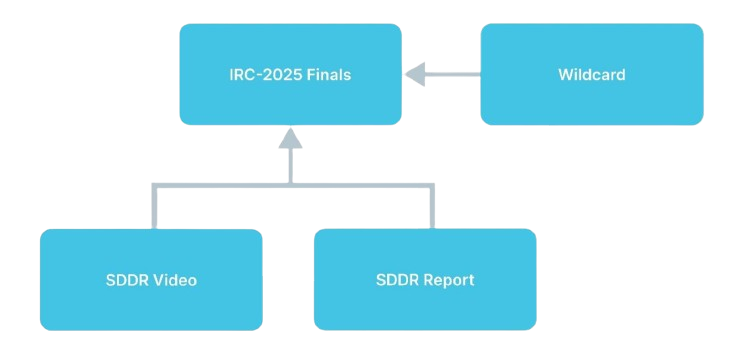
No down-selection for the International Space Drone Challenge. Teams in IRC Finals automatically qualify for the drone category. Out of 26 teams, 3 wildcard entries are reserved for non-Asian teams. Wildcard applicants must showcase their rover in a live presentation to judges before November 20, 2025.


Maximum number of students per team for Finals is unrestricted.


COMPETITION MISSIONS

The Finals consist of missions categorized as Expeditions, Operations, and Assessments. Expeditions like the Astrobiology Expedition (ABEx) involve mobile scientific laboratory tasks, Reconnaissance & Delivery Operation (RDO) focuses on item retrieval and delivery, while Autonomous Expedition (AutEx) tests the rover's autonomous navigation capabilities.


Instrument Deployment & Maintenance Operation (IDMO) involves precise maintenance tasks, and the assessment missions include Project Implementation & Management Assessment (PIMA) and Business Plan Presentation (BPP), focusing on project management and business strategy aspects.


SYSTEM DESIGN AND DEVELOPMENT REVIEW (SDDR)

Teams are required to submit a System Design and Development Review (SDDR) package before November 20, 2025. The SDDR package will focus on both technical and project management aspects of the rover development and has written report and video components.


Project Management Aspects: Teams shall include the organizational structure of the team, resources management, project planning, a PERT chart showing the project timeline, initial budget, fundraising plans, sponsorships, team’s recruitment process, educational and public outreach.


Technical Aspects: Teams shall include the current state of the rover development and prototypes, overall system design, science strategy, and team’s prototype testing strategy.


The video component will be a 5-minute video showcasing salient features of rover design and its readiness. The top 26 teams will advance to the on-site finals based on their normalized score from IRDC and SDDR. All the teams qualified for the IRC Finals will have to confirm their participation by December 5, 2025 at Manipal Institute of Technology Campus, Karnataka, India. If a qualified team is unable to participate in the Finals due to a particular reason, then its spot will be transferred to the highest-ranked reserve team.


Competition Overview

FACULTY ADVISORY ROLE

Size, Weight, and Design Guidelines

Competition Missions (Finals)

The IRC Finals are divided into three categories – Expeditions, Operations, and Assessments.


Expeditions: Missions investigatory in nature with both dynamic and static components. Teams present findings and results to judges after mission completion.


Operations: Missions with only dynamic components where the rover performs specific tasks in the field.


Assessments: Static missions like Project Implementation and Management Assessment (PIMA) and Business and Partnership Plan (BPP).

Teams have a maximum of 30 minutes to complete a field mission. If completed in less than 20 minutes, the team receives a 20% bonus.


If a rover doesn’t cross the starting line within the first 10 minutes, the mission is aborted. Teams scoring more than 20% points in the first 20 minutes can utilize the entire 30-minute mission time; otherwise, they must stop after 20 minutes.


All penalties are additive; e.g., penalties of 10% and 20% result in a score of 70%. All missions are scored independently, and a score less than zero is not possible.


Teams get 10 minutes of setup time before the mission and 10 minutes after completing the mission to disassemble all equipment at the base station. The rover configuration can change throughout the competition based on mission requirements. Teams can make modifications and repairs between missions.

Sproscape

The IRC 2025 Finals will take place within Sproscape, a specially designed 20,000-square-meter simulated terrain. Recognized as the world’s largest arena of its kind, Sproscape features a diverse range of topographical elements, including craters, mounds, rocky gardens, rifts, and quarry fines. The outer perimeter of the arena will house base stations and a dedicated rover testing area, providing a comprehensive and realistic operational environment.


ASTROBIOLOGY EXPEDITION (ABEx)

In this mission, the rover will function as a mobile science laboratory to collect samples from designated sites and perform basic science evaluation of these samples using a suite of carefully designed tests and experiments. The objective is to identify and characterize the sites for their capabilities to support microbial life and seek signs of extinct or extant life in those sites.


The rover may use cameras or other passive instruments to investigate the designated area and collect samples using mechanical methods. The rover must have at least one life-detection capability instrument or assay of the team’s choice. Samples must be investigated by the rover on-site, and at least one sample must be brought back to the base station uncontaminated. There will be no laboratory analysis at the base station. All instruments/tests must be on-board the rover.


After completing roving time, teams will have to submit their conclusions (analysis and findings) to the judges, based on the on-board analysis. Results of on-board rover tests performed, including data and images. This submission should be in a report format.


One month before the IRC Finals, qualified teams will have to present their science plan to the judges in online mode. The presentation date and format will be informed to the teams in November.

RECONNAISSANCE AND AUTONOMOUS DELIVERY OPERATION (RADO)

In this mission, rovers shall conduct reconnaissance operations over terrain not more than 500 metres from the base station, where they must search, locate, pick up, and deliver objects to specific GPS locations or store them for delivery to the base station. The task requires a storage facility and an arm.


Reconnaissance Stage: The rover will have a maximum of 10 minutes to search and locate objects, documenting each with a photograph and GPS coordinates. The rover may pick up and store at most one object (not to be delivered in this stage), and gripping an object for carrying is not allowed.


Autonomous Delivery Stage: The rover will have 20 minutes to pick up and deliver objects to designated locations. Delivery must be completed autonomously to earn full points, while non-autonomous delivery will receive only 50% of the points. Teams must notify judges when entering autonomous mode and declare their delivery mode before the finals. No scouting is allowed before the mission.


Instrument Deployment and Maintenance Operation (IDMO)

This mission will be divided into two stages, Instrument Deployment and Instrument Maintenance. The rover is expected to traverse a short distance to operate on a mock-up instrument panel to perform a set of precise maintenance and deployment operations. The rover will have to use robotic manipulators to carry out this mission.


Picking up a cache and traversing to the panel. The cache will have a handle of at least 10 cm in length and not more than 5 cm in diameter. The cache will weigh less than 5 kg.


The deployment leg of this mission will require teams to retrieve and carry sample cache components for deployment in particular designated locations near the collection panel.


PROJECT IMPLEMENTATION AND MANAGEMENT ASSESSMENT (PIMA)

The objective of the PIMA is the assessment and review of the project and final rover design. PIMA will have one-to-one interaction between the teams and the judges. The teams will have to give a presentation to the judges about their rover development.


This presentation will cover the lessons learned during the whole life cycle of developing a rover, focusing on system engineering and management aspects, from the project plan to manufacturing and testing the rover. Teams may also include spin-offs that have emerged from their rover project. Furthermore, this presentation offers the opportunity for the judges to ask some specific questions.

BUSINESS AND PARTNERSHIP PLAN (BPP)

The objective of the BPP is to evaluate the team’s ability to develop the business acumen of the team and encourage them to build partnerships with the industry and academia, which aids them in the development of their project.