Cosmic Origami: How the James Webb Space Telescope Unfolded to See the Dawn of Time
By Dhruv Pradhan
Imagine a telescope so powerful it doesn't just see the night sky, but journeys back in time. That is what the James Webb Space Telescope (JWST) is all about. Orbiting a million kilometres from Earth, at the gravitationally stable Lagrange Point 2, it peered into the faintest glimmers of the universe, capturing light emitted billions of years ago. Every image it sends back is a peek into cosmic history, long before life on Earth existed.
But the secret to JWST lies in its design. Its huge 6.5-meter mirror collects
infrared light, letting it pierce dust clouds that hide distant objects from
other telescopes. This is crucial because of cosmological redshift-the
stretching of light as the universe expands. Light from the first stars,
once visible, now arrives as infrared waves. JWST's instruments can detect
the atmospheric "fingerprints" of far-off exoplanets and map entire galaxies
in formation. The data it produces from spectra, light curves, and multi-colour
images can fill graphs, charts, and gallery walls alike.
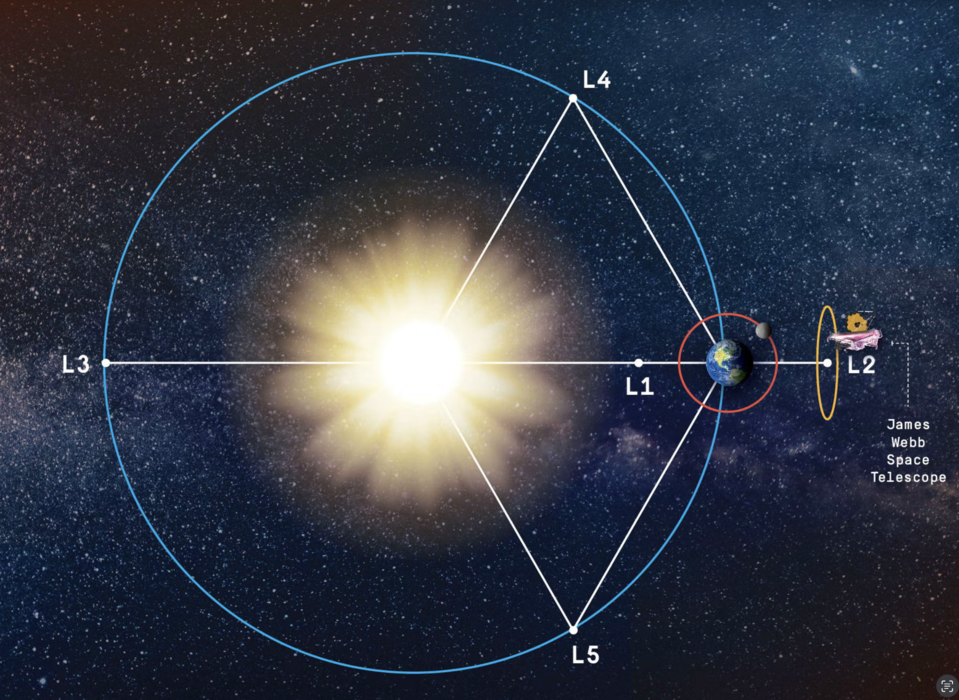
Figure 1: JWST Orbiting the Earth
Its discoveries are already reshaping what we know. JWST has captured massive, surprisingly well-formed galaxies from just 300 million years after the Big Bang, a time when theory predicted only small, chaotic structures. These observations suggest that stars formed faster and assembled into galaxies far earlier than expected, challenging long-standing models of cosmic evolution. By measuring their brightness, structure, and chemical makeup, scientists can trace how matter cooled, clumped, and evolved in the universe’s earliest epochs. Some of these galaxies show signs of mature organization, hinting that the universe may have grown up quicker than our equations once allowed. Every dataset is a puzzle, each image and graph a clue to the universe's grand narrative.
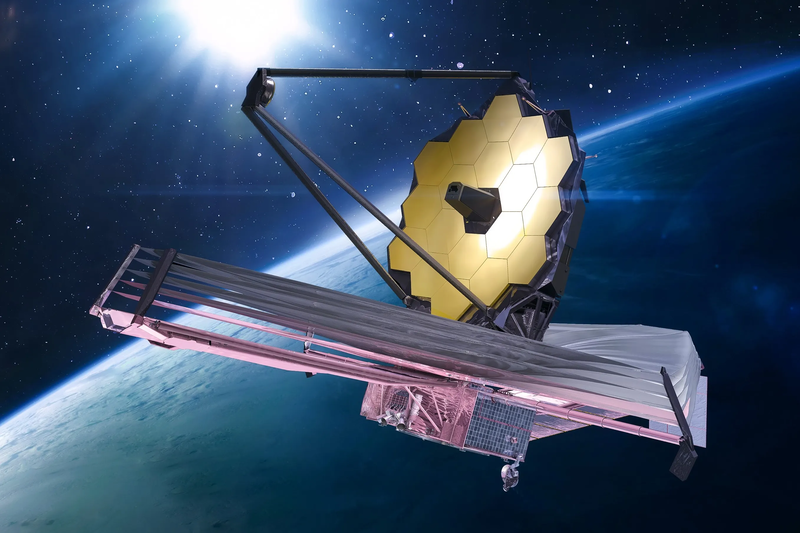
Figure 2: JWST 6.5m reflecting mirror
Behind this sharp vision lies an equally remarkable electrical and control system working quietly in the background. Power comes from a solar array that converts sunlight into electricity, feeding a carefully regulated network that keeps every instrument stable. Thousands of sensors constantly monitor temperature, alignment, and position, while precision electronics adjust the mirror segments by distances smaller than a human hair. Operating in extreme cold, JWST’s electronics must function reliably where even slight noise or instability could blur its view. Every image we see is not just an optical achievement, but the result of finely tuned electrical systems making decisions millions of kilometres away from Earth.
But JWST did not appear overnight. Humanity’s journey to this point is a story of persistence and lessons learned from past attempts. From Galileo’s first spyglass to the Hubble Space Telescope, each generation of telescopes pushed the boundaries, revealing more of the cosmos while exposing new challenges. JWST is the culmination of decades of trial, error, and innovation-a scientific marvel built on the shoulders of these predecessors. Every part, from the mirrors to the sunshield’s folds, reflects decades of careful engineering.
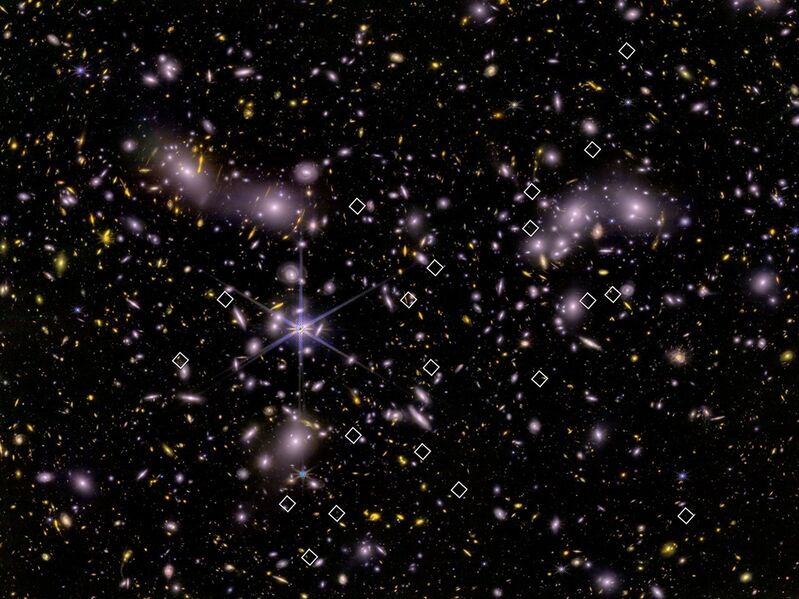
Figure 3: Galaxies observed by the JWST
JWST has captured the very first galaxies ever seen, examined the atmospheres of planets light-years away, and uncovered stellar nurseries hidden deep in cosmic dust. Its instruments can measure chemical signatures with such precision that scientists can find water, carbon dioxide, and even hints of complex molecules in alien atmospheres. These are not just images, but data-rich maps that will inform decades of research and deepen our understanding of galaxy formation, star evolution, and planetary science. As JWST continues to deliver its insights, it reminds us that exploration is incremental and cumulative. Each telescope before JWST taught humanity how to reach further, see sharper, and measure more precisely. JWST is remarkable not because it is perfect, but because it represents the latest step in humanity’s long history of curiosity, patience, and problem-solving. In looking back billions of years with its eyes, we are also looking forward to the future of discovery and to the questions we have yet to imagine. JWST lets us read the universe’s earliest chapters, and in doing so, it reminds us that curiosity is humanity’s greatest telescope.